PROJECT RYME REVIEW
by Psychbomb / January 13, 2026
It’s laser-targeted towards an audience that I’m not quite a part of, but we’re close enough that I can feel the heat coming off of it.
Project RyME is another entry in what I’ve decided to call “desktop detective games”. I get the feeling that I must have gotten that phrase from somewhere else, though I can’t remember where. I’ve seen enough games like this now — Uplink, Hypnospace Outlaw, The Roottrees Are Dead — that I can comfortably call it a subgenre, and a popular one at that. If “Souls-like” only needed about two games to catch on, it feels fair to get this one cemented now.
Desktop detective games require you to interface with a simulated PC to solve mysteries, often involving some form of hacking or digital forensics that require you to dig beneath the surface sites and chatrooms to get to the real nitty-gritty information. It feels as though there weren’t many games in this vein before, but they’ve exploded in popularity in recent years. I would guess that it’s due to the relatively low bar for entry; since the developers are lifting most of their design elements for these games from extant programs in Windows, the way in which the player must interface with all of it has already been accounted for by the multiple decades of live testing and iteration backed by Microsoft’s money and market share. If you’re savvy enough with your machine such that you can figure out how to run the game, then actually playing the game is trivial.
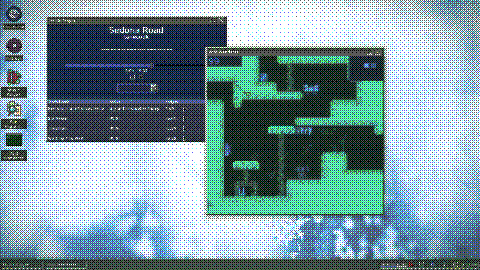
Regardless, Project RyME isn’t really a desktop detective game. It sells itself as one, and it certainly plays a whole lot like one at the start, but it eventually reveals itself to instead be more of a collection of disparate minigames. Some of them are alright, and some of them kind of stink, and they all take away from the hacker feel to make the overarching game come across as unfocused. The part where the Asteroids-esque game is revealed to be an attack vector in disguise was clever, but less so was the hour you have to spend going through a long, clumsy, and generally boring RPG Maker section. Still, I’ve played enough of these games by this point to know that the stuff that I try to eat around is going to be someone else’s favorite part. Perhaps it hits better if you value your novelty to not just be per-game, but intra-game, as well.
Regardless, the actual hacking that’s on display here is pretty good, both in terms of how its represented and how the player is asked to engage with it. Most of what you’re doing involves hefty amounts of social engineering and exploiting publicly-known vulnerabilities on unpatched servers and websites. The game comes with more of a science fiction feel than most contemporaries, so there is some degree of magic involved, but the world here is still grounded enough that “you can remotely edit one memory address on anyone’s computer” is treated with the gravity that such a concept deserves.
It’s this, alongside other story beats, that makes Project RyME go to some interesting places that I find a lot of similar games are too afraid to go. We’re managing to see some fun sci-fi here in an indie scene otherwise plagued by “the computer is haunted”; a writer far less confident in their own work would fill this with purely paranormal elements and an endless series of jumpscares, but Quarq is working with far more restraint than that. Works concerning hypothetical technology like these can lean towards The Matrix, or they can lean towards Pony Island, and I’m very glad to report that this is more Wachowski than Mullins.
To the finer points of the writing, the game does a great job at selling all of these characters. I’ve known every single person here. It’s at a level where I was concerned for a brief moment that the dev and I occupied the same Discord servers ten years back, but there’s just enough different here to make me doubt it. When you’re working to find your missing father (presumably against the clock), and they’re blowing you up in real-time with a hundred messages a minute about some shitty anime that they're liveblogging, there’s no option to mute the server. I figured it was best to get up and go do something else while they talked, and only sat back down at my PC once they had finished. Surprisingly organic!
Exposition can be a little clunky, with one specific instance where a character essentially reads off everyone’s pronouns.page sites in one big loredump. Moments like these in no small part feel like something in the narrative that’s stumbling, because everyone here is so well-realized that I’d already gotten a sense for their identities long before it had been explained to me what those identities were. It’s whatever; I’ve also known a lot of people who spill every single detail about their lives and the lives of everyone else they know without being prompted, so I can’t pretend as though this is unrealistic. Besides, my being aware of something doesn’t mean that everyone else will be, too.
The puzzles, on that note, oscillate between being tricky in a fun way, or being bullshit. It’s always going to be impossible to strike the perfect balance; what I can manage to intuit within a matter of seconds is likely going to stump someone else to the point of quitting, and vice versa. What’s fortunate is that the game has a really good hint system, bundled up inside the little Clippy mascot that lives on your desktop. Not Clippy gets a little confused sometimes, eagerly offering hints for sections I’d already completed, but it otherwise excelled at pushing me in the right direction without giving me the answers outright. There’s a full in-game walkthrough provided for you if you really need it, but I was able to get by without.
Project RyME is a game that’s taken the kitchen sink approach, cobbled together from so many incongruous ideas that it becomes a bit of a challenge to find the core concept by which it can all come together. What it also is, however, is compelling. It had me hooked. Rare is the game in this subgenre that can march to the front of the line with some fresh ideas and interesting concepts. While the undisputed king remains Uplink (with his heir being the good prince Hacknet), Project RyME is as close to being a claimant to the throne as I’ve seen any of these other desktop detective games get. What it lacks in cohesion, it more than makes up for in its individual moments.
Calling the Touhou clone “MikoMaho” was an inspired choice.